import torch
import torch.nn as nn
import torch.optim as optim
import torchvision
import torchvision.transforms as transforms
import torchvision.models as models
import matplotlib.pyplot as plt
import matplotlib.patches as mpatches
import numpy as np
import time
from collections import defaultdict

# Reproducibility
torch.manual_seed(42)
np.random.seed(42)

device = torch.device("cuda" if torch.cuda.is_available() else "cpu")
print(f"Using device: {device}")
if device.type == "cuda":
    print(f"GPU: {torch.cuda.get_device_name(0)}")
else:
    print("⚠️  No GPU found. Training will be slower. Consider Runtime > Change runtime type > T4 GPU")
Using device: cuda
GPU: Tesla T4
# ── Data ──────────────────────────────────
transform_train = transforms.Compose([
    transforms.ToTensor(),
    transforms.Normalize((0.5, 0.5, 0.5), (0.5, 0.5, 0.5))
])
transform_test = transforms.Compose([
    transforms.ToTensor(),
    transforms.Normalize((0.5, 0.5, 0.5), (0.5, 0.5, 0.5))
])

trainset = torchvision.datasets.CIFAR10('./data', train=True,  download=True, transform=transform_train)
testset  = torchvision.datasets.CIFAR10('./data', train=False, download=True, transform=transform_test)

trainloader = torch.utils.data.DataLoader(trainset, batch_size=128, shuffle=True,  num_workers=2)
testloader  = torch.utils.data.DataLoader(testset,  batch_size=128, shuffle=False, num_workers=2)
100%|██████████| 170M/170M [00:35<00:00, 4.82MB/s]
Lets build the same architecture we used in Lab4.
# MLP Model
class MLP(nn.Module):
    def __init__(self, input_dim=3072, hidden_sizes=[256, 128], num_classes=10, dropout=0.1):
        super().__init__()
        layers = []
        prev_size = input_dim
        for h in hidden_sizes:
            layers += [
                nn.Linear(prev_size, h),
                nn.ReLU(),
                nn.Dropout(dropout),
            ]
            prev_size = h
        layers.append(nn.Linear(prev_size, num_classes))

        self.network = nn.Sequential(nn.Flatten(), *layers)
        self._init_weights()

    def _init_weights(self):
        for m in self.modules():
            if isinstance(m, nn.Linear):
                nn.init.kaiming_uniform_(m.weight, nonlinearity='relu')
                nn.init.zeros_(m.bias)

    def forward(self, x):
        return self.network(x)


model = MLP().to(device)
total_params = sum(p.numel() for p in model.parameters() if p.requires_grad)
print(f"\nMLP architecture : 3072 → 256 → 128 → 10")
print(f"Total parameters : {total_params:,}")
MLP architecture : 3072 → 256 → 128 → 10
Total parameters : 820,874
# Train MLP with same hyperparameters: Relu, Adam, Cosine Annealing, Weight Decay, Dropout
NUM_EPOCHS = 20

optimizer = optim.Adam(model.parameters(), lr=0.001, weight_decay=1e-4)
scheduler = optim.lr_scheduler.CosineAnnealingLR(optimizer, T_max=NUM_EPOCHS)
criterion = nn.CrossEntropyLoss()

history = {'train_loss': [], 'test_acc': [], 'lr': []}


print("Training MLP on CIFAR-10")

for epoch in range(NUM_EPOCHS):
    t0 = time.time()

    # Train
    model.train()
    total_loss = 0
    for inputs, labels in trainloader:
        inputs, labels = inputs.to(device), labels.to(device)
        optimizer.zero_grad()
        loss = criterion(model(inputs), labels)
        loss.backward()
        optimizer.step()
        total_loss += loss.item()

    # Evaluate
    model.eval()
    correct = total = 0
    with torch.no_grad():
        for inputs, labels in testloader:
            inputs, labels = inputs.to(device), labels.to(device)
            preds = model(inputs).argmax(dim=1)
            correct += preds.eq(labels).sum().item()
            total   += labels.size(0)

    avg_loss = total_loss / len(trainloader)
    acc      = 100. * correct / total

    scheduler.step()
    lr_now = scheduler.get_last_lr()[0]

    history['train_loss'].append(avg_loss)
    history['test_acc'].append(acc)
    history['lr'].append(lr_now)

    print(f"Epoch [{epoch+1:2d}/{NUM_EPOCHS}]  "
          f"Loss: {avg_loss:.4f}  "
          f"Test Acc: {acc:.1f}%  "
          f"LR: {lr_now:.5f}  "
          f"({time.time()-t0:.1f}s)")

print(f"\n✓ Best Test Accuracy: {max(history['test_acc']):.1f}%")
Training MLP on CIFAR-10
Epoch [ 1/20] Loss: 1.7701 Test Acc: 45.1% LR: 0.00099 (18.4s)
Epoch [ 2/20] Loss: 1.5582 Test Acc: 46.9% LR: 0.00098 (16.7s)
Epoch [ 3/20] Loss: 1.4630 Test Acc: 50.1% LR: 0.00095 (16.6s)
Epoch [ 4/20] Loss: 1.3899 Test Acc: 51.0% LR: 0.00090 (15.6s)
Epoch [ 5/20] Loss: 1.3335 Test Acc: 51.5% LR: 0.00085 (13.7s)
Epoch [ 6/20] Loss: 1.2821 Test Acc: 52.9% LR: 0.00079 (13.7s)
Epoch [ 7/20] Loss: 1.2379 Test Acc: 52.7% LR: 0.00073 (14.4s)
Epoch [ 8/20] Loss: 1.1864 Test Acc: 53.6% LR: 0.00065 (15.1s)
Epoch [ 9/20] Loss: 1.1447 Test Acc: 54.1% LR: 0.00058 (14.4s)
Epoch [10/20] Loss: 1.0977 Test Acc: 54.8% LR: 0.00050 (16.8s)
Epoch [11/20] Loss: 1.0547 Test Acc: 55.0% LR: 0.00042 (15.9s)
Epoch [12/20] Loss: 1.0104 Test Acc: 55.5% LR: 0.00035 (18.3s)
Epoch [13/20] Loss: 0.9684 Test Acc: 55.8% LR: 0.00027 (15.2s)
Epoch [14/20] Loss: 0.9264 Test Acc: 56.0% LR: 0.00021 (13.8s)
Epoch [15/20] Loss: 0.8932 Test Acc: 56.2% LR: 0.00015 (14.9s)
Epoch [16/20] Loss: 0.8596 Test Acc: 56.5% LR: 0.00010 (15.0s)
Epoch [17/20] Loss: 0.8351 Test Acc: 56.8% LR: 0.00005 (13.5s)
Epoch [18/20] Loss: 0.8206 Test Acc: 56.6% LR: 0.00002 (20.9s)
Epoch [19/20] Loss: 0.8050 Test Acc: 56.6% LR: 0.00001 (20.0s)
Epoch [20/20] Loss: 0.7999 Test Acc: 56.6% LR: 0.00000 (16.2s)
✓ Best Test Accuracy: 56.8%
# Plot MLP Training Result
epochs = range(1, NUM_EPOCHS + 1)
fig, axes = plt.subplots(1, 3, figsize=(16, 4))

axes[0].plot(epochs, history['train_loss'], 'b-o', linewidth=2, markersize=4)
axes[0].set_title('Training Loss', fontweight='bold')
axes[0].set_xlabel('Epoch')
axes[0].set_ylabel('Loss')
axes[0].grid(True, alpha=0.3)

axes[1].plot(epochs, history['test_acc'], 'g-o', linewidth=2, markersize=4)
axes[1].axhline(y=10, color='red', linestyle='--', alpha=0.5, label='Random (10%)')
axes[1].set_title('Test Accuracy', fontweight='bold')
axes[1].set_xlabel('Epoch')
axes[1].set_ylabel('Accuracy (%)')
axes[1].legend()
axes[1].grid(True, alpha=0.3)

axes[2].plot(epochs, history['lr'], 'r-o', linewidth=2, markersize=4)
axes[2].set_title('Learning Rate (Cosine Annealing)', fontweight='bold')
axes[2].set_xlabel('Epoch')
axes[2].set_ylabel('LR')
axes[2].grid(True, alpha=0.3)

plt.suptitle(f'MLP on CIFAR-10  |  Best Accuracy: {max(history["test_acc"]):.1f}%',
             fontsize=13, fontweight='bold')
plt.tight_layout()
plt.savefig('mlp_training.png', dpi=150, bbox_inches='tight')
plt.show()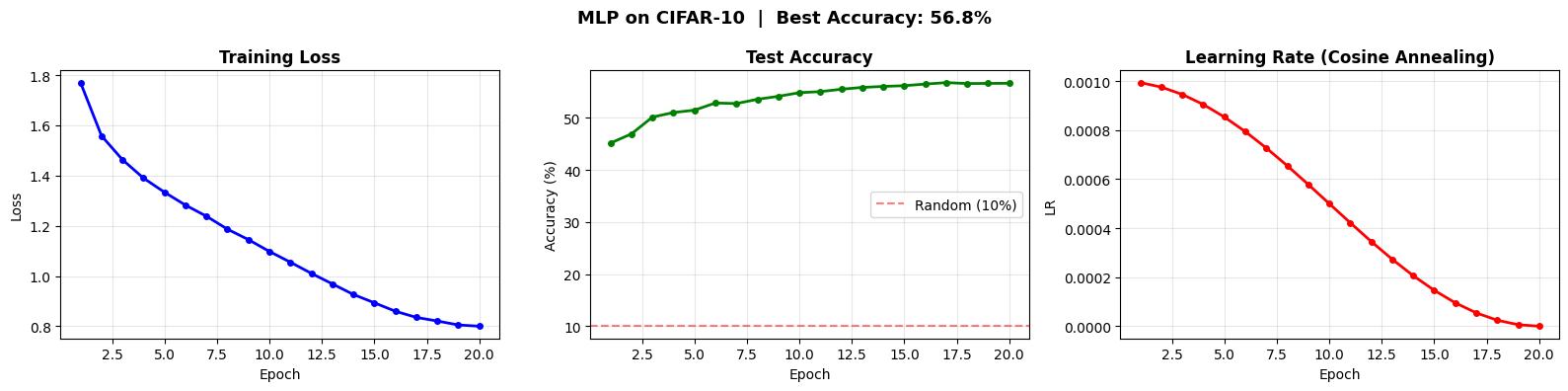
Why MLPs is not the best practice for Image Classification ?
# REASON 1: Flattening destroys spatial structure
# The MLP has NO idea which pixels are neighbors
transform_raw  = transforms.ToTensor()
transform_norm = transforms.Compose([
    transforms.ToTensor(),
    transforms.Normalize((0.5, 0.5, 0.5), (0.5, 0.5, 0.5))
])
dataset_raw  = torchvision.datasets.CIFAR10('./data', train=False, download=False, transform=transform_raw)
dataset_norm = torchvision.datasets.CIFAR10('./data', train=False, download=False, transform=transform_norm)
classes = ['plane', 'car', 'bird', 'cat', 'deer', 'dog', 'frog', 'horse', 'ship', 'truck']

def get_sample(dataset, label_idx):
    for img, label in dataset:
        if label == label_idx:
            return img

label_indices = [3, 5, 1, 6]   # cat, dog, car, frog
true_names    = ['Cat', 'Dog', 'Car', 'Frog']
raws  = [get_sample(dataset_raw,  i) for i in label_indices]
norms = [get_sample(dataset_norm, i) for i in label_indices]
cat_raw = get_sample(dataset_raw, 3)

fig, axes = plt.subplots(1, 2, figsize=(10, 4))  # Changed to 1x2, reduced figsize
fig.suptitle('Flattening Destroys Spatial Structure', fontsize=13, fontweight='bold')

# Original 2D image
axes[0].imshow(cat_raw.permute(1, 2, 0).clip(0, 1).numpy())
axes[0].set_title('What you see\n2D image (32×32×3)', fontweight='bold', fontsize=11, color='#2980b9')
axes[0].axis('off')

# Flattened: show as a 1D strip
flat = cat_raw.reshape(3, -1).permute(1, 0)   # (3072, 3)
axes[1].imshow(flat.unsqueeze(0).numpy(), aspect='auto')
axes[1].set_title('What the MLP sees\n3072 numbers in a row', fontweight='bold', fontsize=11, color='#e74c3c')
axes[1].set_xlabel('Pixel values (R, G, B)', fontsize=9)
axes[1].set_yticks([])

plt.tight_layout()

plt.savefig('mlp_flattening.png', dpi=150, bbox_inches='tight')
plt.show()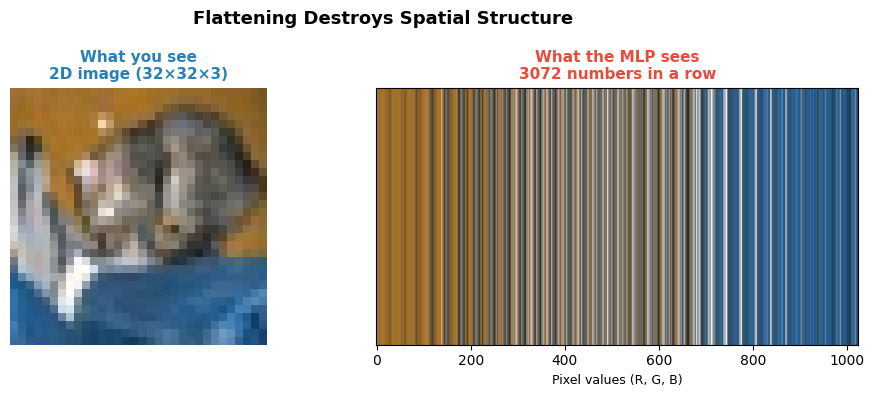
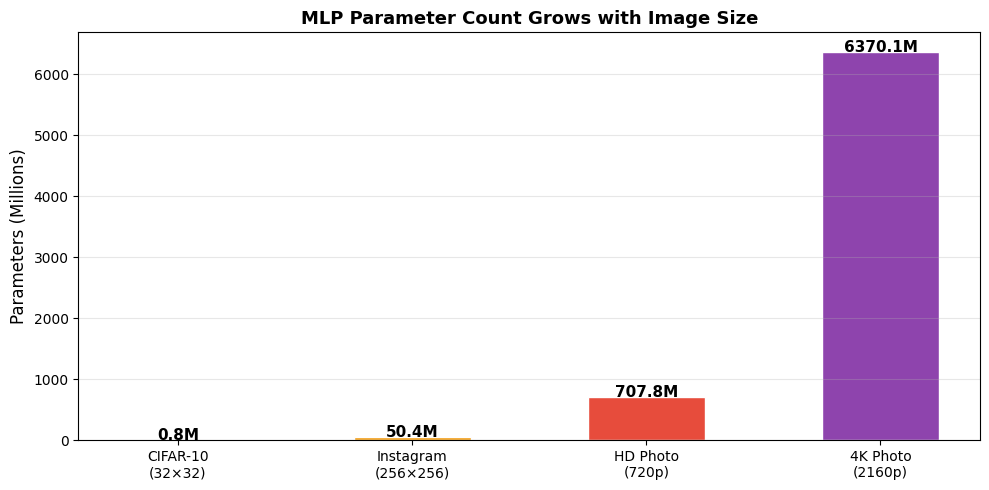
# REASON 2: They explode with input size

image_sizes = [
    ("CIFAR-10\n(32×32)",    (32,  32,  3)),
    ("Instagram\n(256×256)", (256, 256, 3)),
    ("HD Photo\n(720p)",     (1280, 720, 3)),
    ("4K Photo\n(2160p)",    (3840, 2160, 3)),
]

def count_mlp_parameters(image_size, hidden_sizes, num_classes=10):
    """Count parameters for an MLP on an image."""
    input_dim = image_size[0] * image_size[1] * image_size[2]
    layers = [input_dim] + hidden_sizes + [num_classes]
    total = 0
    for i in range(len(layers) - 1):
        params = layers[i] * layers[i+1] + layers[i+1]  # weights + biases
        total += params
    return total, input_dim

param_counts = []
for label, size in image_sizes:
    params, _ = count_mlp_parameters(size, [256, 128])
    param_counts.append(params)
    print(f"{label.replace(chr(10), ' '):<25} → {params:>15,} parameters")

fig, ax = plt.subplots(figsize=(10, 5))
labels  = [s[0] for s in image_sizes]
colors  = ['#27AE60', '#F39C12', '#E74C3C', '#8E44AD']
bars    = ax.bar(labels, [p / 1e6 for p in param_counts], color=colors, edgecolor='white', width=0.5)

for bar, p in zip(bars, param_counts):
    ax.text(bar.get_x() + bar.get_width()/2, bar.get_height() + 0.5,
            f'{p/1e6:.1f}M', ha='center', fontsize=11, fontweight='bold')

ax.set_ylabel('Parameters (Millions)', fontsize=12)
ax.set_title('MLP Parameter Count Grows with Image Size',
             fontsize=13, fontweight='bold')
ax.grid(True, alpha=0.3, axis='y')
plt.tight_layout()
plt.savefig('param_explosion.png', dpi=150, bbox_inches='tight')
plt.show()
CIFAR-10 (32×32) → 820,874 parameters
Instagram (256×256) → 50,366,090 parameters
HD Photo (720p) → 707,823,242 parameters
4K Photo (2160p) → 6,370,133,642 parameters
Lets create a small CNN Architecture.
class CNN(nn.Module):
    def __init__(self, num_classes=10):
        super().__init__()
        self.features = nn.Sequential(
            # Block 1: 32×32 → 16×16
            nn.Conv2d(3, 16, kernel_size=3, padding=1),
            nn.ReLU(),
            nn.MaxPool2d(2, 2),

            # Block 2: 16×16 → 8×8
            nn.Conv2d(16, 32, kernel_size=3, padding=1),
            nn.ReLU(),
            nn.MaxPool2d(2, 2),
        )
        self.classifier = nn.Sequential(
            nn.Flatten(),           # 32×8×8 = 2048
            nn.Linear(2048, 128),
            nn.ReLU(),
            nn.Linear(128, num_classes),
        )

    def forward(self, x):
        return self.classifier(self.features(x))

cnn_model = CNN().to(device)
mlp_params = sum(p.numel() for p in model.parameters() if p.requires_grad)
cnn_params = sum(p.numel() for p in cnn_model.parameters() if p.requires_grad)
print(f"MLP parameters : {mlp_params:,}")
print(f"CNN parameters : {cnn_params:,}")
print(f"CNN uses {mlp_params / cnn_params:.1f}x FEWER parameters than MLP")
MLP parameters : 820,874
CNN parameters : 268,650
CNN uses 3.1x FEWER parameters than MLP
# Train CNN
NUM_EPOCHS = 20

cnn_optimizer  = optim.Adam(cnn_model.parameters(), lr=0.001, weight_decay=1e-4)
cnn_scheduler  = optim.lr_scheduler.CosineAnnealingLR(cnn_optimizer, T_max=NUM_EPOCHS)
criterion      = nn.CrossEntropyLoss()

cnn_history = {'train_loss': [], 'test_acc': []}

print("Training CNN on CIFAR-10")

for epoch in range(NUM_EPOCHS):
    t0 = time.time()

    cnn_model.train()
    total_loss = 0
    for inputs, labels in trainloader:
        inputs, labels = inputs.to(device), labels.to(device)
        cnn_optimizer.zero_grad()
        loss = criterion(cnn_model(inputs), labels)
        loss.backward()
        cnn_optimizer.step()
        total_loss += loss.item()

    cnn_model.eval()
    correct = total = 0
    with torch.no_grad():
        for inputs, labels in testloader:
            inputs, labels = inputs.to(device), labels.to(device)
            preds = cnn_model(inputs).argmax(dim=1)
            correct += preds.eq(labels).sum().item()
            total   += labels.size(0)

    avg_loss = total_loss / len(trainloader)
    acc      = 100. * correct / total
    cnn_scheduler.step()

    cnn_history['train_loss'].append(avg_loss)
    cnn_history['test_acc'].append(acc)

    print(f"Epoch [{epoch+1:2d}/{NUM_EPOCHS}]  Loss: {avg_loss:.4f}  Test Acc: {acc:.1f}%  ({time.time()-t0:.1f}s)")

print(f"\n✓ MLP Best Accuracy : {max(history['test_acc']):.1f}%")
print(f"✓ CNN Best Accuracy : {max(cnn_history['test_acc']):.1f}%")
Training CNN on CIFAR-10
Epoch [ 1/20] Loss: 1.5438 Test Acc: 53.4% (18.7s)
Epoch [ 2/20] Loss: 1.2091 Test Acc: 60.3% (17.1s)
Epoch [ 3/20] Loss: 1.0654 Test Acc: 63.5% (14.6s)
Epoch [ 4/20] Loss: 0.9657 Test Acc: 64.4% (16.5s)
Epoch [ 5/20] Loss: 0.8953 Test Acc: 66.3% (17.0s)
Epoch [ 6/20] Loss: 0.8263 Test Acc: 67.0% (20.6s)
Epoch [ 7/20] Loss: 0.7737 Test Acc: 68.2% (18.7s)
Epoch [ 8/20] Loss: 0.7256 Test Acc: 68.2% (19.0s)
Epoch [ 9/20] Loss: 0.6774 Test Acc: 68.4% (17.7s)
Epoch [10/20] Loss: 0.6380 Test Acc: 69.6% (20.7s)
Epoch [11/20] Loss: 0.5983 Test Acc: 69.1% (21.2s)
Epoch [12/20] Loss: 0.5625 Test Acc: 70.0% (17.3s)
Epoch [13/20] Loss: 0.5318 Test Acc: 70.0% (14.9s)
Epoch [14/20] Loss: 0.5028 Test Acc: 70.2% (14.8s)
Epoch [15/20] Loss: 0.4793 Test Acc: 70.1% (14.5s)
Epoch [16/20] Loss: 0.4607 Test Acc: 70.3% (17.7s)
Epoch [17/20] Loss: 0.4446 Test Acc: 70.1% (15.6s)
Epoch [18/20] Loss: 0.4341 Test Acc: 70.6% (14.5s)
Epoch [19/20] Loss: 0.4265 Test Acc: 70.4% (15.1s)
Epoch [20/20] Loss: 0.4224 Test Acc: 70.4% (14.6s)
✓ MLP Best Accuracy : 56.8%
✓ CNN Best Accuracy : 70.6%
# Reason3: Invariance
# ─────────────────────────────────────────────
# 1. Lets create synthetic dataset for object detection and show that how CNNs are translation equivariant.
#    Canvas: 64×64
#    Object: 16×16 white square with an inner darker ring

CANVAS   = 64
OBJ_SIZE = 16

import matplotlib.pyplot as plt
import matplotlib.patches as patches  # ← add this
import numpy as np
import torch
import torch.nn as nn
import torch.optim as optim
from torch.utils.data import Dataset, DataLoader

class ObjectDataset(Dataset):
    def __init__(self, n=3000):
        self.imgs, self.boxes = [], []
        max_pos = CANVAS - OBJ_SIZE
        for _ in range(n):
            canvas = np.zeros((1, CANVAS, CANVAS), dtype=np.float32)
            x = np.random.randint(0, max_pos)
            y = np.random.randint(0, max_pos)
            # outer bright ring
            canvas[0, y:y+OBJ_SIZE, x:x+OBJ_SIZE] = 1.0
            # inner darker fill — creates edge structure
            canvas[0, y+3:y+OBJ_SIZE-3, x+3:x+OBJ_SIZE-3] = 0.4
            # add tiny noise so MLP can't trivially memorize
            canvas += np.random.randn(1, CANVAS, CANVAS).astype(np.float32) * 0.05
            canvas = np.clip(canvas, 0, 1)
            self.imgs.append(canvas)
            # store normalised (x_center, y_center, w, h)
            self.boxes.append([
                (x + OBJ_SIZE / 2) / CANVAS,
                (y + OBJ_SIZE / 2) / CANVAS,
                OBJ_SIZE / CANVAS,
                OBJ_SIZE / CANVAS,
            ])
        self.imgs  = torch.tensor(np.array(self.imgs))
        self.boxes = torch.tensor(np.array(self.boxes), dtype=torch.float32)

    def __len__(self): return len(self.imgs)
    def __getitem__(self, i): return self.imgs[i], self.boxes[i]


# 2. MODELS
class MLPDetector(nn.Module):
    def __init__(self):
        super().__init__()
        self.net = nn.Sequential(
            nn.Flatten(),
            nn.Linear(CANVAS * CANVAS, 512), nn.ReLU(),
            nn.Linear(512, 256),             nn.ReLU(),
            nn.Linear(256, 4),               nn.Sigmoid(),
        )
    def forward(self, x): return self.net(x)


class CNNDetector(nn.Module):
    def __init__(self):
        super().__init__()
        self.features = nn.Sequential(
            nn.Conv2d(1, 16, 3, padding=1), nn.ReLU(),
            nn.MaxPool2d(2),                          # 64→32
            nn.Conv2d(16, 32, 3, padding=1), nn.ReLU(),
            nn.MaxPool2d(2),                          # 32→16
            nn.Conv2d(32, 64, 3, padding=1), nn.ReLU(),
            nn.MaxPool2d(2),                          # 16→8
        )
        self.head = nn.Sequential(
            nn.Flatten(),
            nn.Linear(64 * 8 * 8, 256), nn.ReLU(),
            nn.Linear(256, 4),          nn.Sigmoid(),
        )
    def forward(self, x): return self.head(self.features(x))

# 3. TRAINING
def train(model, loader, epochs=25, lr=1e-3):
    opt      = optim.Adam(model.parameters(), lr=lr)
    criterion = nn.MSELoss()
    model.train()
    for epoch in range(epochs):
        total = 0
        for imgs, boxes in loader:
            opt.zero_grad()
            loss = criterion(model(imgs), boxes)
            loss.backward()
            opt.step()
            total += loss.item()
        if (epoch + 1) % 5 == 0:
            print(f"  epoch {epoch+1:3d}/{epochs}  loss={total/len(loader):.5f}")
    return model


def iou(pred, gt, canvas=CANVAS):
    def to_xyxy(b):
        cx, cy, w, h = b
        return (cx - w/2) * canvas, (cy - h/2) * canvas, \
               (cx + w/2) * canvas, (cy + h/2) * canvas

    px1, py1, px2, py2 = to_xyxy(pred)
    gx1, gy1, gx2, gy2 = to_xyxy(gt)

    ix1, iy1 = max(px1, gx1), max(py1, gy1)
    ix2, iy2 = min(px2, gx2), min(py2, gy2)
    inter = max(0, ix2 - ix1) * max(0, iy2 - iy1)
    union = (px2-px1)*(py2-py1) + (gx2-gx1)*(gy2-gy1) - inter
    return inter / union if union > 0 else 0.0


print("Building dataset...")
dataset    = ObjectDataset(n=3000)
loader     = DataLoader(dataset, batch_size=64, shuffle=True)

print("\nTraining MLP...")
mlp = MLPDetector()
mlp = train(mlp, loader, epochs=25)

print("\nTraining CNN...")
cnn = CNNDetector()
cnn = train(cnn, loader, epochs=25)


# 4. SHIFT HELPER
def shift_image(img, shift):
    """Shift image tensor (1,H,W) by `shift` pixels down-right."""
    shifted = torch.zeros_like(img)
    shifted[:, shift:, shift:] = img[:, :CANVAS-shift, :CANVAS-shift]
    return shifted

def predict_box(model, img_tensor):
    model.eval()
    with torch.no_grad():
        pred = model(img_tensor.unsqueeze(0)).squeeze().numpy()
    return pred

def box_to_rect(pred, color, label, canvas=CANVAS):
    """Convert normalised (cx,cy,w,h) → matplotlib Rectangle."""
    cx, cy, w, h = pred
    x1 = (cx - w/2) * canvas
    y1 = (cy - h/2) * canvas
    return patches.Rectangle(
        (x1, y1), w * canvas, h * canvas,
        linewidth=2.5, edgecolor=color, facecolor='none',
        label=label
    )


# 5. PICK 4 TEST SAMPLES & THEIR SHIFTED VERSIONS
# Use samples NOT in the training distribution
# by placing objects at fixed, well-separated positions

test_positions = [(8, 8), (36, 8), (8, 36), (30, 30)]
SHIFT = 16

test_imgs, test_boxes, shifted_imgs, shifted_boxes = [], [], [], []

for (x, y) in test_positions:
    canvas_np = np.zeros((1, CANVAS, CANVAS), dtype=np.float32)
    canvas_np[0, y:y+OBJ_SIZE, x:x+OBJ_SIZE] = 1.0
    canvas_np[0, y+3:y+OBJ_SIZE-3, x+3:x+OBJ_SIZE-3] = 0.4
    img = torch.tensor(canvas_np)

    sx, sy = min(x + SHIFT, CANVAS - OBJ_SIZE), min(y + SHIFT, CANVAS - OBJ_SIZE)
    test_imgs.append(img)
    test_boxes.append([(x + OBJ_SIZE/2)/CANVAS, (y + OBJ_SIZE/2)/CANVAS,
                        OBJ_SIZE/CANVAS, OBJ_SIZE/CANVAS])
    shifted_imgs.append(shift_image(img, SHIFT))
    shifted_boxes.append([(sx + OBJ_SIZE/2)/CANVAS, (sy + OBJ_SIZE/2)/CANVAS,
                           OBJ_SIZE/CANVAS, OBJ_SIZE/CANVAS])


# 6. COMPUTE IoU FOR ANNOTATION
mlp_iou_orig, mlp_iou_shift = [], []
cnn_iou_orig, cnn_iou_shift = [], []

for img, box, simg, sbox in zip(test_imgs, test_boxes, shifted_imgs, shifted_boxes):
    mlp_iou_orig.append(iou(predict_box(mlp, img),   box))
    mlp_iou_shift.append(iou(predict_box(mlp, simg), sbox))
    cnn_iou_orig.append(iou(predict_box(cnn, img),   box))
    cnn_iou_shift.append(iou(predict_box(cnn, simg), sbox))

print(f"\nMean IoU  |  original  |  shifted {SHIFT}px")
print(f"MLP       |  {np.mean(mlp_iou_orig):.3f}     |  {np.mean(mlp_iou_shift):.3f}")
print(f"CNN       |  {np.mean(cnn_iou_orig):.3f}     |  {np.mean(cnn_iou_shift):.3f}")


# 7. VISUALISE
fig, axes = plt.subplots(4, 4, figsize=(14, 14))
fig.suptitle(
    'Bounding Box Prediction: Equivariance Demo\n'
    'Does the predicted box follow the object when it shifts?',
    fontsize=13, fontweight='bold', y=1.01
)

col_titles = [
    'Original  —  MLP', 'Shifted  —  MLP',
    'Original  —  CNN', 'Shifted  —  CNN'
]
col_colors = ['#e74c3c', '#e74c3c', '#27ae60', '#27ae60']

for col, (title, color) in enumerate(zip(col_titles, col_colors)):
    axes[0, col].set_title(title, fontsize=10, fontweight='bold',
                            color=color, pad=8)

for row in range(4):
    orig_img  = test_imgs[row]
    shft_img  = shifted_imgs[row]
    gt_orig   = test_boxes[row]
    gt_shift  = shifted_boxes[row]

    mlp_pred_orig  = predict_box(mlp, orig_img)
    mlp_pred_shift = predict_box(mlp, shft_img)
    cnn_pred_orig  = predict_box(cnn, orig_img)
    cnn_pred_shift = predict_box(cnn, shft_img)

    configs = [
        (orig_img,  mlp_pred_orig,  gt_orig,  '#e74c3c', mlp_iou_orig[row]),
        (shft_img,  mlp_pred_shift, gt_shift, '#e74c3c', mlp_iou_shift[row]),
        (orig_img,  cnn_pred_orig,  gt_orig,  '#27ae60', cnn_iou_orig[row]),
        (shft_img,  cnn_pred_shift, gt_shift, '#27ae60', cnn_iou_shift[row]),
    ]

    for col, (img_t, pred, gt, model_color, score) in enumerate(configs):
        ax = axes[row, col]
        ax.imshow(img_t.squeeze().numpy(), cmap='gray', vmin=0, vmax=1)

        # ground truth box (white dashed)
        ax.add_patch(box_to_rect(gt, 'white', 'GT'))
        gt_rect = patches.Rectangle(
            ((gt[0]-gt[2]/2)*CANVAS, (gt[1]-gt[3]/2)*CANVAS),
            gt[2]*CANVAS, gt[3]*CANVAS,
            linewidth=1.5, edgecolor='white',
            facecolor='none', linestyle='--'
        )
        ax.add_patch(gt_rect)

        # predicted box (colored)
        ax.add_patch(box_to_rect(pred, model_color, 'Pred'))

        ax.set_xticks([])
        ax.set_yticks([])

        # IoU label
        iou_color = '#2ecc71' if score > 0.4 else '#e74c3c'
        ax.set_xlabel(f'IoU = {score:.2f}', fontsize=9,
                      fontweight='bold', color=iou_color, labelpad=3)

        # border color = model color
        for spine in ax.spines.values():
            spine.set_visible(True)
            spine.set_edgecolor(model_color)
            spine.set_linewidth(2.5)

# Row labels
for row in range(4):
    axes[row, 0].set_ylabel(f'Sample {row+1}', fontsize=10,
                             fontweight='bold', labelpad=8)

# Legend

plt.tight_layout()
plt.savefig('bbox_equivariance_demo.png', dpi=150, bbox_inches='tight')
plt.show()
Building dataset...
Training MLP...
epoch 5/25 loss=0.00000
epoch 10/25 loss=0.00000
epoch 15/25 loss=0.00000
epoch 20/25 loss=0.00000
epoch 25/25 loss=0.00000
Training CNN...
epoch 5/25 loss=0.00001
epoch 10/25 loss=0.00000
epoch 15/25 loss=0.00000
epoch 20/25 loss=0.00000
epoch 25/25 loss=0.00000
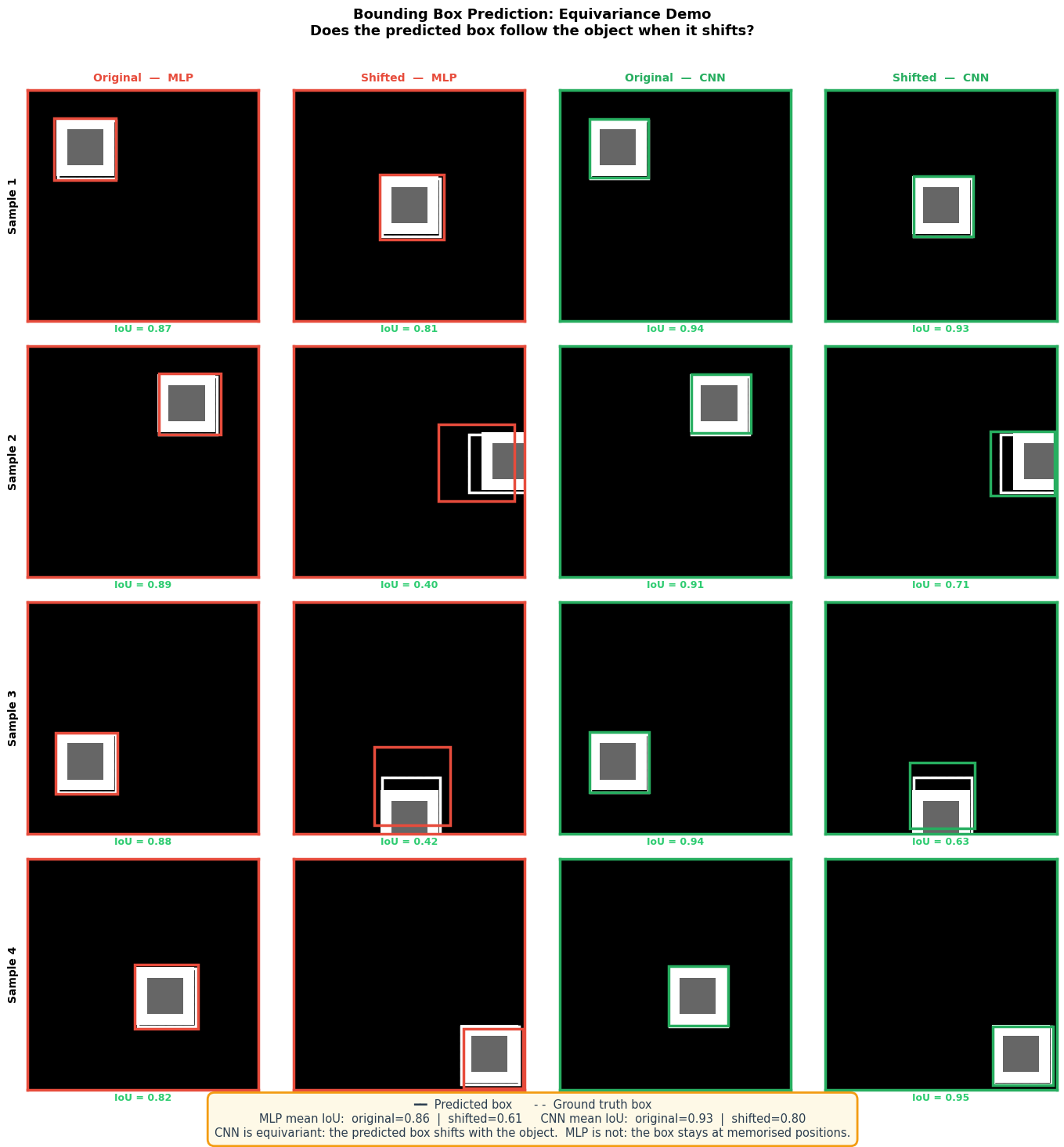
Mean IoU | original | shifted 16px
MLP | 0.864 | 0.612
CNN | 0.925 | 0.804
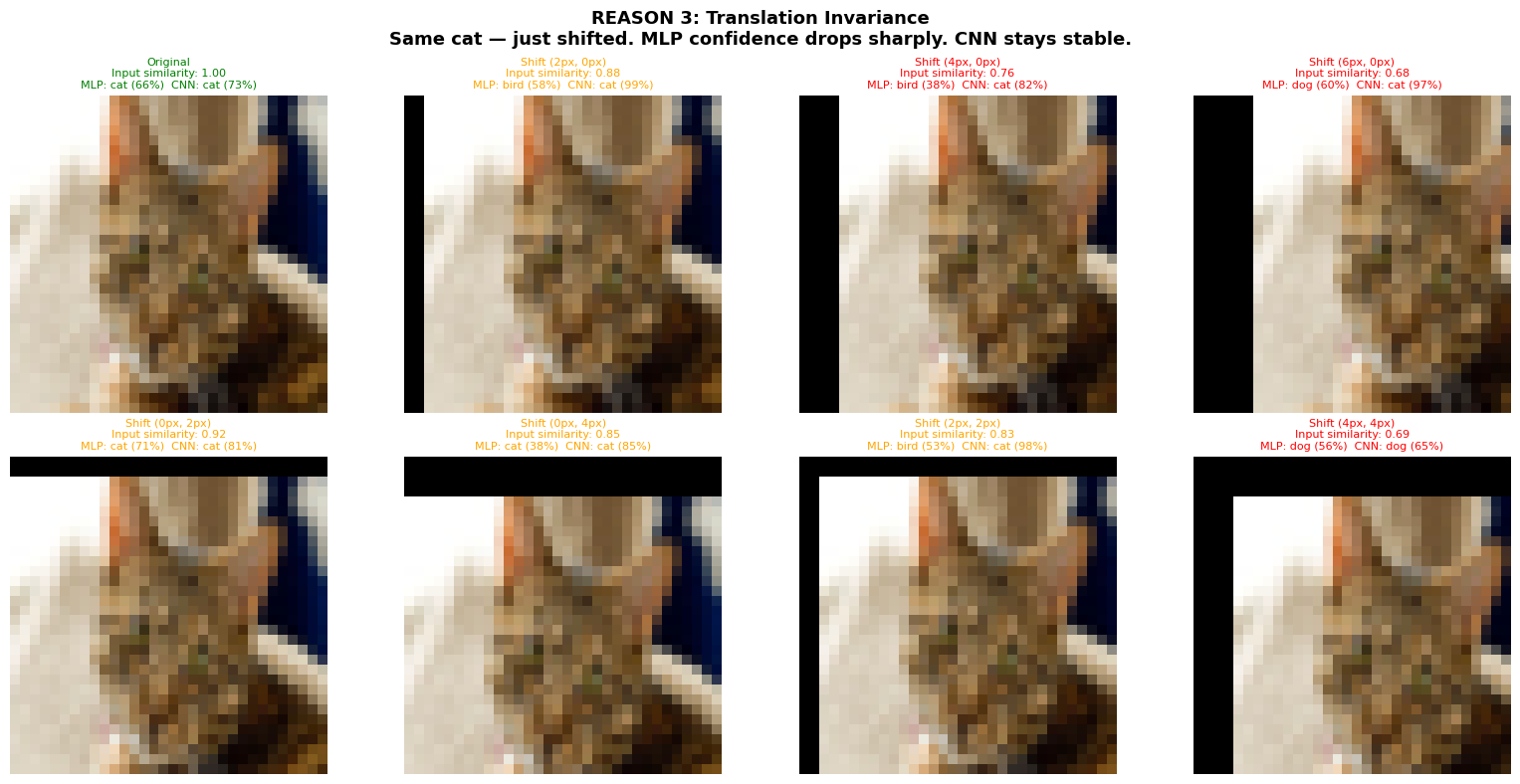
# Reason3: Translation Invariance
class_names = ['plane', 'car', 'bird', 'cat', 'deer', 'dog', 'frog', 'horse', 'ship', 'truck']

# Find a cat that BOTH models classify correctly with high confidence
cat_img = None
for i, (img_tensor, label) in enumerate(testset):
    if label != 3:
        continue
    img_unnorm = img_tensor * 0.5 + 0.5
    mlp_cls, mlp_conf = get_confidence(img_unnorm, model)
    cnn_cls, cnn_conf = get_confidence(img_unnorm, cnn_model)
    if mlp_cls == 3 and cnn_cls == 3 and mlp_conf > 60 and cnn_conf > 60:
        cat_img = img_unnorm
        print(f"Found good cat at index {i}: MLP={mlp_conf:.0f}%  CNN={cnn_conf:.0f}%")
        break

if cat_img is None:
    print("No high-confidence cat found — lowering thresholds...")
    for i, (img_tensor, label) in enumerate(testset):
        if label != 3:
            continue
        img_unnorm = img_tensor * 0.5 + 0.5
        mlp_cls, mlp_conf = get_confidence(img_unnorm, model)
        cnn_cls, cnn_conf = get_confidence(img_unnorm, cnn_model)
        if mlp_cls == 3 and cnn_cls == 3:
            cat_img = img_unnorm
            print(f"Found cat at index {i}: MLP={mlp_conf:.0f}%  CNN={cnn_conf:.0f}%")
            break

def shift_image(img, dx, dy):
    shifted = torch.zeros_like(img)
    x0, x1 = max(dx, 0), min(32 + dx, 32)
    y0, y1 = max(dy, 0), min(32 + dy, 32)
    sx0, sx1 = max(-dx, 0), min(32 - dx, 32)
    sy0, sy1 = max(-dy, 0), min(32 - dy, 32)
    shifted[:, y0:y1, x0:x1] = img[:, sy0:sy1, sx0:sx1]
    return shifted

def get_confidence(img_tensor, mdl):
    mdl.eval()
    x = (img_tensor - 0.5) / 0.5
    with torch.no_grad():
        logits = mdl(x.unsqueeze(0).to(device))
        probs  = torch.softmax(logits, dim=1)
    top_prob, top_cls = probs[0].max(0)
    return top_cls.item(), top_prob.item() * 100

# Small shifts for 32×32 images
shifts = [(0,0), (2,0), (4,0), (6,0), (0,2), (0,4), (2,2), (4,4)]

fig, axes = plt.subplots(2, 4, figsize=(16, 8))

for ax, (dx, dy) in zip(axes.flat, shifts):
    shifted = shift_image(cat_img, dx, dy)
    cos_sim = float(
        torch.nn.functional.cosine_similarity(
            cat_img.flatten().unsqueeze(0),
            shifted.flatten().unsqueeze(0)
        ).item()
    )
    mlp_cls, mlp_conf = get_confidence(shifted, model)
    cnn_cls, cnn_conf = get_confidence(shifted, cnn_model)

    ax.imshow(shifted.permute(1, 2, 0).clip(0, 1).numpy())
    ax.axis('off')

    is_original = (dx == 0 and dy == 0)
    title  = "Original\n" if is_original else f"Shift ({dx}px, {dy}px)\n"
    title += f"Input similarity: {cos_sim:.2f}\n"
    title += f"MLP: {class_names[mlp_cls]} ({mlp_conf:.0f}%)  "
    title += f"CNN: {class_names[cnn_cls]} ({cnn_conf:.0f}%)"
    color  = 'green' if is_original else ('orange' if cos_sim > 0.8 else 'red')
    ax.set_title(title, fontsize=8, color=color)

plt.suptitle(
    'REASON 3: Translation Invariance\n'
    'Same cat — just shifted. MLP confidence drops sharply. CNN stays stable.',
    fontsize=13, fontweight='bold'
)
plt.tight_layout()
plt.savefig('reason3_translation_invariance.png', dpi=150, bbox_inches='tight')
plt.show()
Found good cat at index 103: MLP=66% CNN=73%
Pretrained CNNs
# We can use pretrained models for transfer learning with Pretrained ResNet-18
# Goal: freeze backbone - cache features - only train head
# To make it more efficient we will extract features once

import time
import torch
import torch.nn as nn
import torch.optim as optim
import torchvision
import torchvision.transforms as transforms
import torchvision.models as models

device = torch.device("cuda" if torch.cuda.is_available() else "cpu")
print(f"Using device: {device}\n")

# We need different DataLoaders for pretrained models because pretrained models expect this ---> 224×224
pretrain_transform_train = transforms.Compose([
    transforms.Resize(224),
    transforms.RandomHorizontalFlip(),
    transforms.RandomCrop(224, padding=14),
    transforms.ToTensor(),
    transforms.Normalize([0.485, 0.456, 0.406],
                         [0.229, 0.224, 0.225]),
])
pretrain_transform_test = transforms.Compose([
    transforms.Resize(224),
    transforms.ToTensor(),
    transforms.Normalize([0.485, 0.456, 0.406],
                         [0.229, 0.224, 0.225]),
])

pretrain_trainset = torchvision.datasets.CIFAR10(
    root='./data', train=True,  download=True, transform=pretrain_transform_train)
pretrain_testset  = torchvision.datasets.CIFAR10(
    root='./data', train=False, download=True, transform=pretrain_transform_test)

# Use smaller batch for extraction
extract_trainloader = torch.utils.data.DataLoader(
    pretrain_trainset, batch_size=128, shuffle=False, num_workers=2, pin_memory=True)
extract_testloader  = torch.utils.data.DataLoader(
    pretrain_testset,  batch_size=256, shuffle=False, num_workers=2, pin_memory=True)

# Load Pretrained ResNet-18 & strip the FC head
resnet_full = models.resnet18(weights=models.ResNet18_Weights.IMAGENET1K_V1)
backbone = nn.Sequential(*list(resnet_full.children())[:-1])  # removes fc, keeps avgpool
backbone = backbone.to(device)
backbone.eval()

# Freeze everything: we only use this for feature extraction
for param in backbone.parameters():
    param.requires_grad = False

# Pre-compute features (runs ONCE, saves redundant fwd passes)
def extract_features(loader, model, desc=""):
    features_list, labels_list = [], []
    print(f"Extracting {desc} features...", end=" ", flush=True)
    t0 = time.time()
    with torch.no_grad():
        for inputs, labels in loader:
            inputs = inputs.to(device)
            feats = model(inputs)          # (B, 512, 1, 1)
            features_list.append(feats.squeeze(-1).squeeze(-1).cpu())  # (B, 512)
            labels_list.append(labels)
    features = torch.cat(features_list)   # (N, 512)
    labels   = torch.cat(labels_list)     # (N,)
    print(f"done in {time.time()-t0:.1f}s  →  shape {tuple(features.shape)}")
    return features, labels

train_feats, train_labels = extract_features(extract_trainloader, backbone, "train")
test_feats,  test_labels  = extract_features(extract_testloader,  backbone, "test")

# Lightweight DataLoaders .
feat_trainset = torch.utils.data.TensorDataset(train_feats, train_labels)
feat_testset  = torch.utils.data.TensorDataset(test_feats,  test_labels)

feat_trainloader = torch.utils.data.DataLoader(
    feat_trainset, batch_size=256, shuffle=True)
feat_testloader  = torch.utils.data.DataLoader(
    feat_testset,  batch_size=512, shuffle=False)

# Define the head only: 512 → 10 (we have 10 classes for cifar10)
head = nn.Linear(512, 10).to(device)

total_params     = sum(p.numel() for p in head.parameters())

print(f"  ResNet-18  │  Linear Probing on CIFAR-10 (fast mode)")
print(f"  Trainable params   : {total_params:>10,} only the 10-class head")
print(f"  Backbone forward   :  extracted ONCE, not every epoch")


# Train the head on cached features
PRETRAIN_EPOCHS  = 20
resnet_optimizer = optim.Adam(head.parameters(), lr=1e-3, weight_decay=1e-4)
resnet_scheduler = optim.lr_scheduler.CosineAnnealingLR(resnet_optimizer, T_max=PRETRAIN_EPOCHS)
criterion        = nn.CrossEntropyLoss()

resnet_history = {'train_loss': [], 'test_acc': []}

print("Training: ONLY fc head on pre-computed 512-d features\n")

for epoch in range(PRETRAIN_EPOCHS):
    t0 = time.time()
    head.train()
    total_loss = 0
    for feats, labels in feat_trainloader:
        feats, labels = feats.to(device), labels.to(device)
        resnet_optimizer.zero_grad()
        loss = criterion(head(feats), labels)
        loss.backward()
        resnet_optimizer.step()
        total_loss += loss.item()

    head.eval()
    correct = total = 0
    with torch.no_grad():
        for feats, labels in feat_testloader:
            feats, labels = feats.to(device), labels.to(device)
            preds = head(feats).argmax(dim=1)
            correct += preds.eq(labels).sum().item()
            total   += labels.size(0)

    avg_loss = total_loss / len(feat_trainloader)
    acc      = 100. * correct / total
    resnet_scheduler.step()
    resnet_history['train_loss'].append(avg_loss)
    resnet_history['test_acc'].append(acc)
    print(f"Epoch [{epoch+1:2d}/{PRETRAIN_EPOCHS}]  Loss: {avg_loss:.4f}  "
          f"Test Acc: {acc:.1f}%  ({time.time()-t0:.1f}s)")

print(f"\n✓ ResNet-18 ({total_params:,} params)  : {max(resnet_history['test_acc']):.1f}%")
Using device: cuda
Downloading: "https://download.pytorch.org/models/resnet18-f37072fd.pth" to /root/.cache/torch/hub/checkpoints/resnet18-f37072fd.pth
100%|██████████| 44.7M/44.7M [00:00<00:00, 190MB/s]
Extracting train features... done in 116.0s  →  shape (50000, 512)
Extracting test features... done in 24.9s  →  shape (10000, 512)
  ResNet-18  │  Linear Probing on CIFAR-10 (fast mode)
  Trainable params   :      5,130 only the 10-class head
  Backbone forward   :  extracted ONCE, not every epoch
Training: ONLY fc head on pre-computed 512-d features

Epoch [ 1/20]  Loss: 0.8173  Test Acc: 82.0%  (0.6s)
Epoch [ 2/20]  Loss: 0.4654  Test Acc: 83.6%  (0.8s)
Epoch [ 3/20]  Loss: 0.4185  Test Acc: 84.3%  (0.6s)
Epoch [ 4/20]  Loss: 0.3947  Test Acc: 85.4%  (0.7s)
Epoch [ 5/20]  Loss: 0.3813  Test Acc: 85.2%  (0.9s)
Epoch [ 6/20]  Loss: 0.3723  Test Acc: 85.5%  (0.9s)
Epoch [ 7/20]  Loss: 0.3643  Test Acc: 85.7%  (0.7s)
Epoch [ 8/20]  Loss: 0.3587  Test Acc: 85.8%  (0.6s)
Epoch [ 9/20]  Loss: 0.3541  Test Acc: 85.5%  (1.2s)
Epoch [10/20]  Loss: 0.3498  Test Acc: 85.8%  (0.7s)
Epoch [11/20]  Loss: 0.3472  Test Acc: 86.0%  (1.0s)
Epoch [12/20]  Loss: 0.3438  Test Acc: 85.8%  (0.9s)
Epoch [13/20]  Loss: 0.3422  Test Acc: 86.0%  (0.6s)
Epoch [14/20]  Loss: 0.3402  Test Acc: 86.1%  (0.6s)
Epoch [15/20]  Loss: 0.3385  Test Acc: 86.0%  (0.6s)
Epoch [16/20]  Loss: 0.3372  Test Acc: 86.0%  (0.8s)
Epoch [17/20]  Loss: 0.3365  Test Acc: 86.1%  (0.6s)
Epoch [18/20]  Loss: 0.3353  Test Acc: 86.0%  (0.6s)
Epoch [19/20]  Loss: 0.3348  Test Acc: 86.0%  (0.6s)
Epoch [20/20]  Loss: 0.3342  Test Acc: 86.1%  (0.6s)

✓ ResNet-18 (5,130 params)  : 86.1%
#  We do transfer Learning with pretrained vision transformer
#  Goal: Pre-extract [CLS] features ONCE → only train head
#  We apply the same trick as: backbone runs exactly once

!pip install timm --quiet

import timm
import time
import torch
import torch.nn as nn
import torch.optim as optim


# Build 224×224 ImageNet-normalised loaders
import torchvision
import torchvision.transforms as transforms

pretrain_transform = transforms.Compose([
    transforms.Resize(224),
    transforms.ToTensor(),
    transforms.Normalize(mean=[0.485, 0.456, 0.406],
                         std=[0.229, 0.224, 0.225]),   # ImageNet stats
])

pretrain_trainset = torchvision.datasets.CIFAR10(
    root='./data', train=True,  download=True, transform=pretrain_transform)
pretrain_testset  = torchvision.datasets.CIFAR10(
    root='./data', train=False, download=True, transform=pretrain_transform)

pretrain_trainloader = torch.utils.data.DataLoader(
    pretrain_trainset, batch_size=256, shuffle=False, num_workers=2)
pretrain_testloader  = torch.utils.data.DataLoader(
    pretrain_testset,  batch_size=512, shuffle=False, num_workers=2)

print("Loaders ready — 224×224, ImageNet normalisation ✓")


# Load Pretrained ViT-Small
#  num_classes=0 → timm removes the head entirely and returns
#  the raw [CLS] token embedding instead of class logits.
#  This is the key difference vs ResNet where we sliced children().
vit_backbone = timm.create_model(
    'vit_small_patch16_224',
    pretrained=True,
    num_classes=0          # ← removes head, outputs [CLS] embedding
)
vit_backbone = vit_backbone.to(device)
vit_backbone.eval()

for param in vit_backbone.parameters():
    param.requires_grad = False

# What is the [CLS] embedding size?
#  ViT-Small hidden dim = 384  (if we have used Base=768, or Large=1024)
#  We extract this ONCE and cache it: same idea as ResNet's
dummy = torch.zeros(1, 3, 224, 224).to(device)
with torch.no_grad():
    cls_dim = vit_backbone(dummy).shape[-1]
print(f"ViT [CLS] embedding dimension: {cls_dim}")   # → 384

# Pre-compute [CLS] features (runs ONCE)
def extract_features(loader, model, desc=""):
    features_list, labels_list = [], []
    print(f"Extracting {desc} features...", end=" ", flush=True)
    t0 = time.time()
    with torch.no_grad():
        for inputs, labels in loader:
            inputs = inputs.to(device)
            cls_tokens = model(inputs)          # (B, 384) — [CLS] token only
            features_list.append(cls_tokens.cpu())
            labels_list.append(labels)
    features = torch.cat(features_list)         # (N, 384)
    labels   = torch.cat(labels_list)           # (N,)
    print(f"done in {time.time()-t0:.1f}s  →  shape {tuple(features.shape)}")
    return features, labels

vit_train_feats, vit_train_labels = extract_features(pretrain_trainloader, vit_backbone, "ViT train")
vit_test_feats,  vit_test_labels  = extract_features(pretrain_testloader,  vit_backbone, "ViT test")

# Lightweight DataLoaders
vit_feat_trainset = torch.utils.data.TensorDataset(vit_train_feats, vit_train_labels)
vit_feat_testset  = torch.utils.data.TensorDataset(vit_test_feats,  vit_test_labels)

vit_feat_trainloader = torch.utils.data.DataLoader(
    vit_feat_trainset, batch_size=256, shuffle=True)
vit_feat_testloader  = torch.utils.data.DataLoader(
    vit_feat_testset,  batch_size=512, shuffle=False)

# Define head only (384 → 10)
vit_head = nn.Linear(cls_dim, 10).to(device)

vit_total     = sum(p.numel() for p in vit_backbone.parameters()) + sum(p.numel() for p in vit_head.parameters())
vit_trainable = sum(p.numel() for p in vit_head.parameters())


print(f"  ViT-Small Transfer Learning  │  CIFAR-10 (fast mode)")
print(f"  Total parameters   : {vit_total:>10,}")
print(f"  Trainable params   : {vit_trainable:>10,}  ← only {100*vit_trainable/vit_total:.2f}% updated!")
print(f"  [CLS] embed dim    : {cls_dim}  (vs ResNet's 512-d avgpool)")

# Train head on cached [CLS] features
VIT_EPOCHS    = 20
vit_optimizer = optim.Adam(vit_head.parameters(), lr=1e-3, weight_decay=1e-4)
vit_scheduler = optim.lr_scheduler.CosineAnnealingLR(vit_optimizer, T_max=VIT_EPOCHS)
criterion     = nn.CrossEntropyLoss()

vit_history = {'train_loss': [], 'test_acc': []}

print("Training: ONLY linear head on pre-computed 384-d [CLS] tokens\n")

for epoch in range(VIT_EPOCHS):
    t0 = time.time()
    vit_head.train()
    total_loss = 0
    for feats, labels in vit_feat_trainloader:
        feats, labels = feats.to(device), labels.to(device)
        vit_optimizer.zero_grad()
        loss = criterion(vit_head(feats), labels)
        loss.backward()
        vit_optimizer.step()
        total_loss += loss.item()

    vit_head.eval()
    correct = total = 0
    with torch.no_grad():
        for feats, labels in vit_feat_testloader:
            feats, labels = feats.to(device), labels.to(device)
            preds = vit_head(feats).argmax(dim=1)
            correct += preds.eq(labels).sum().item()
            total   += labels.size(0)

    avg_loss = total_loss / len(vit_feat_trainloader)
    acc      = 100. * correct / total
    vit_scheduler.step()
    vit_history['train_loss'].append(avg_loss)
    vit_history['test_acc'].append(acc)
    print(f"Epoch [{epoch+1:2d}/{VIT_EPOCHS}]  Loss: {avg_loss:.4f}  "
          f"Test Acc: {acc:.1f}%  ({time.time()-t0:.1f}s)")


print(f"  Final Accuracy Leaderboard")
print(f"  MLP      (scratch)              : {max(history['test_acc']):.1f}%")
print(f"  CNN      (scratch)              : {max(cnn_history['test_acc']):.1f}%")
print(f"  ResNet-18 (pretrained, head only): {max(resnet_history['test_acc']):.1f}%")
print(f"  ViT-Small (pretrained, head only): {max(vit_history['test_acc']):.1f}%")

print(f"\n→ MLP < CNN < Pretrained ResNet < Pretrained ViT ")
print(f"→ ViT trained {100*vit_trainable/vit_total:.2f}% of its weights and beat everything!")
Loaders ready — 224×224, ImageNet normalisation ✓
/usr/local/lib/python3.12/dist-packages/huggingface_hub/utils/_auth.py:94: UserWarning:
The secret `HF_TOKEN` does not exist in your Colab secrets.
To authenticate with the Hugging Face Hub, create a token in your settings tab (https://huggingface.co/settings/tokens), set it as secret in your Google Colab and restart your session.
You will be able to reuse this secret in all of your notebooks.
Please note that authentication is recommended but still optional to access public models or datasets.
  warnings.warn(
Loading...
ViT [CLS] embedding dimension: 384
Extracting ViT train features... done in 197.2s  →  shape (50000, 384)
Extracting ViT test features... done in 40.7s  →  shape (10000, 384)
  ViT-Small Transfer Learning  │  CIFAR-10 (fast mode)
  Total parameters   : 21,669,514
  Trainable params   :      3,850  ← only 0.02% updated!
  [CLS] embed dim    : 384  (vs ResNet's 512-d avgpool)
Training: ONLY linear head on pre-computed 384-d [CLS] tokens

Epoch [ 1/20]  Loss: 0.4164  Test Acc: 91.9%  (0.6s)
Epoch [ 2/20]  Loss: 0.2049  Test Acc: 92.8%  (0.6s)
Epoch [ 3/20]  Loss: 0.1830  Test Acc: 92.9%  (0.6s)
Epoch [ 4/20]  Loss: 0.1716  Test Acc: 93.0%  (0.6s)
Epoch [ 5/20]  Loss: 0.1640  Test Acc: 93.2%  (0.8s)
Epoch [ 6/20]  Loss: 0.1587  Test Acc: 93.3%  (0.6s)
Epoch [ 7/20]  Loss: 0.1547  Test Acc: 93.4%  (0.6s)
Epoch [ 8/20]  Loss: 0.1512  Test Acc: 93.6%  (0.8s)
Epoch [ 9/20]  Loss: 0.1482  Test Acc: 93.3%  (0.8s)
Epoch [10/20]  Loss: 0.1458  Test Acc: 93.5%  (0.8s)
Epoch [11/20]  Loss: 0.1440  Test Acc: 93.3%  (0.6s)
Epoch [12/20]  Loss: 0.1418  Test Acc: 93.5%  (0.6s)
Epoch [13/20]  Loss: 0.1396  Test Acc: 93.5%  (0.8s)
Epoch [14/20]  Loss: 0.1390  Test Acc: 93.7%  (0.6s)
Epoch [15/20]  Loss: 0.1371  Test Acc: 93.7%  (0.6s)
Epoch [16/20]  Loss: 0.1361  Test Acc: 93.6%  (0.6s)
Epoch [17/20]  Loss: 0.1349  Test Acc: 93.7%  (0.6s)
Epoch [18/20]  Loss: 0.1340  Test Acc: 93.7%  (0.6s)
Epoch [19/20]  Loss: 0.1339  Test Acc: 93.7%  (0.6s)
Epoch [20/20]  Loss: 0.1336  Test Acc: 93.7%  (0.6s)
  Final Accuracy Leaderboard
  MLP      (scratch)              : 56.8%
  CNN      (scratch)              : 70.6%
  ResNet-18 (pretrained, head only): 86.1%
  ViT-Small (pretrained, head only): 93.7%

→ MLP < CNN < Pretrained ResNet < Pretrained ViT ✓
→ ViT trained 0.02% of its weights and beat everything!